

AI-Assisted Values Alignment Across Marquette L. Walker Ministries:
Supporting organizational culture, inclusion, and ethical clarity in a global, remote faith-based team
Liana H. Meyer
Independent Researcher, Future Tense
January 2026
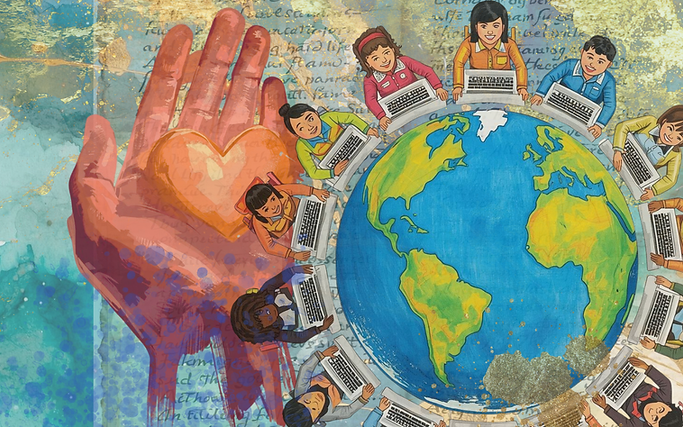
AI Image created by Liana H. Meyer
Abstract
In 2025, a faith-based ministry and its newly launched nonprofit foundation undertook an AI-assisted values alignment initiative to strengthen their organizational culture across a global, fully remote team. This case study examines how Marquette L. Walker Ministries (MLWM) and Marquette’s Destiny Foundation (MDF) co-developed a set of core values and cultural guidelines through an online survey process augmented by AI tools. Operating with no dedicated budget and a volunteer, board, and staff audience dispersed across time zones, the organization leveraged AI to design survey questions, analyze qualitative feedback, and map values to scripture under human oversight. The process yielded a co-created Culture & Values document anchored in faith principles yet written in an inclusive tone for all team members. Key outcomes included stronger shared understanding of values, improved inclusion in decision-making, and a reusable framework for onboarding and governance. This case demonstrates how AI can accelerate participatory culture-building in mission-driven organizations while maintaining ethical clarity and human judgment.
Keywords:
AI-assisted analysis; organizational values; organizational culture; values alignment; remote teams; faith-based organizations; participatory governance; ethical AI use; qualitative survey analysis; human-in-the-loop systems; nonprofit management; organizational decision-making
Context
Founded by Dr. Marquette L. Walker in North Carolina, Marquette L. Walker Ministries (MLWM) provides faith-based crisis support and spiritual growth, particularly for women in crisis. In 2025, Dr. Walker expanded this mission by launching Marquette’s Destiny Foundation (MDF), a 501(c)(3) nonprofit serving women, men, and at-risk youth facing challenges such as homelessness and addiction. United by a vision of “healing and purpose,” MLWM and MDF now operate as a fully remote, global organization without a physical office.
With staff, volunteers, and board members working asynchronously across regions, sustaining a shared culture requires intentional communication and clearly articulated values. As the team grew in size and diversity, leadership recognized the need to explicitly define and align the organization’s core values. Guided by the founder’s belief that “every individual has a God-given destiny,” the organization launched an internal process to co-create a values framework—one that would reflect its Christian foundation while fostering inclusion, clarity, and cohesion in a remote, multicultural environment.
Problem Definition
The challenge was to design a values alignment process that was inclusive, efficient, and well-suited to a fully remote, faith-based organization. Leadership needed to assess how well team members understood the ministry’s values and gather input to refine them into a clear, actionable framework. Key constraints included:
-
Global Remote Team: Staff, volunteers, and board members were spread across time zones, requiring an asynchronous, virtual format to ensure broad participation.
-
No Budget: With limited resources, the team had to rely on free tools and internal capacity, using AI to extend their reach without external consultants.
-
Diverse Stakeholder Participation: The process had to engage staff, volunteers, and board directors while respecting their time—requiring a survey that was quick yet meaningful.
-
Faith-Informed, Inclusive Tone: The framework needed to reflect Christian principles without sounding doctrinal, making space for different spiritual backgrounds and experiences.
-
Mixed-Methods Insight: Leadership wanted both quantitative indicators and qualitative depth, demanding a survey that combined ratings with open-ended reflection.
-
Practical Utility: Above all, the outcome needed to be immediately useful—grounded in real work, not abstract ideals—to shape decision-making and culture across both MLWM and MDF.
Method & Judgment Applied
MLWM/MDF implemented a structured, AI-assisted values alignment process that combined digital tools with human discernment at each step. The approach unfolded in phases:
-
Initial Values Drafting: Leadership proposed six core values—Faithfulness to God’s Calling, Service with Compassion, Excellence in All We Do, Stewardship of God’s Gifts, Collaboration in Love, and Purpose in Action—each paired with a relevant scripture. AI tools helped refine tone and phrasing for clarity and inclusiveness, with human oversight ensuring theological integrity.
-
Survey Design with AI Support: A free online platform hosted the Core Values Feedback Survey, which included scaled ratings and open-ended prompts. AI assisted in structuring unbiased, accessible questions and phrasing. Participants were also invited to suggest additional values or provide general input.
-
Global Asynchronous Deployment: The survey was shared with staff, volunteers, and board members across both organizations. A two-week response window and anonymity ensured inclusive, candid participation across time zones.
-
AI-Accelerated Analysis: AI tools clustered and summarized qualitative responses to identify recurring themes and language patterns. The independent researcher then reviewed and adjusted these summaries to preserve nuance and reflect minority views.
-
Values Refinement and Mapping: Feedback affirmed the original values but surfaced opportunities for clearer definitions and practical examples. AI was used to generate supporting content—including scripture, plain-language explanations, and context-specific behaviors—which was then edited for tone, clarity, and alignment with the organization’s mission.
-
Co-Creation and Review: Leadership, including Dr. Walker, reviewed the final Culture & Values document. The result was a co-created, visually shareable resource grounded in team input, AI-assisted drafting, and human editorial judgment.
This blended approach allowed the team to move quickly and inclusively while maintaining clarity, faith alignment, and ownership.
Ethics & Safeguards
Given the sensitive nature of personal values, religious context, and AI-assisted analysis, the project prioritized strong ethical safeguards:
-
Confidentiality & Consent: Participation was voluntary and anonymous, encouraging honest input without fear of reprisal. Leadership clearly stated that responses would inform improvement, not individual evaluation.
-
Transparency: From survey launch to results sharing, the team maintained openness about purpose, process, and next steps. This closed the feedback loop and built trust among participants.
-
Responsible AI Use: AI tools supported—but never replaced—human judgment. No personal identifiers were shared with AI systems, and all AI outputs (e.g., summaries, phrasing suggestions, scripture references) were reviewed and edited by a human facilitator to ensure accuracy, relevance, and respect.
-
Faith-Informed, Inclusive Framing: Values were articulated in positive, inclusive terms grounded in Christian principles. Each was paired with plain-language explanations to ensure accessibility regardless of theological background. Language remained invitational rather than prescriptive, reviewed for cultural sensitivity by both the founder and an external advisor.
-
No Harm, Net Benefit: The design prioritized safety and constructive engagement. There was no public attribution of individual feedback, and the outcome—an inclusive, shared values document—serves as a safeguard for ethical decision-making.
-
Accountability: Board members were kept informed, and leadership participated throughout, reinforcing oversight, credibility, and alignment with organizational standards.
The overall process modeled respectful, human-centered use of technology in a mission-driven setting.
Governance / Risk Implications
This case underscores that values alignment functions as a form of organizational governance, particularly in remote and mission-driven contexts where informal cultural signals are limited. Clearly articulated, shared values reduce ambiguity in decision-making and help distribute interpretive authority beyond individual leaders.
The use of AI introduces both efficiency gains and governance risk. Without human oversight, AI-assisted analysis can flatten nuance, privilege dominant voices, or introduce framing bias. Maintaining a human-in-the-loop model—supported by leadership review and clear accountability—was essential to mitigating these risks.
Finally, internal trust and inclusion represent material risk factors. Anonymous participation, transparent communication, and careful faith framing were necessary safeguards to prevent erosion of trust or perceived coercion. Embedded into everyday practice, values can strengthen governance; treated as symbolic, they can undermine it.
Outcomes & Findings
The initiative culminated in a practical Culture & Core Values document, shared with the entire team and embedded into onboarding and organizational resources. Each of the six values—such as Service with Compassion and Collaboration in Love—included a Biblical reference, a plain-language explanation, and examples of how the value shows up in remote, day-to-day work. Framed accessibly, the document now serves as a touchstone for decision-making and team interactions.
Survey Insights:
The survey confirmed strong alignment with the organization’s mission. Participants broadly affirmed that their work reflects biblical values and purpose. Key takeaways included:
-
Clarifying “Faithfulness to God’s Calling”: Some respondents sought clearer articulation of this value in workplace terms—whether it meant devotional practice, integrity, or discernment. The final document clarified it as prayerful, purpose-aligned work rather than ritual.
-
Need for Fellowship: While Collaboration in Love was affirmed, respondents noted a lack of relational connection in the remote format. This highlighted the need for intentional community-building opportunities.
-
Value Coverage Confirmed: Few saw gaps; most felt the six core values were sufficient, with suggestions like Integrity seen as already embedded in existing principles.
Tangible Results:
-
Integrated Onboarding: The values guide was incorporated into new staff and volunteer orientation, setting cultural expectations from the start.
-
Boosted Engagement: Participation in the process increased morale and ownership. Team members felt heard, which likely strengthens retention and alignment.
-
Cost & Time Efficiency: The initiative was completed in weeks with no external costs, thanks to AI-assisted design and analysis. Frameworks created are now reusable for future surveys or reflection exercises, making the model both scalable and sustainable.
Implications for Practice
This case offers several takeaways for faith-based nonprofits, startups, and remote teams seeking to align values and culture—especially with limited resources:
-
AI as a Tool for Inclusion: Used thoughtfully, AI can amplify human voices by summarizing and clustering feedback at scale—especially useful for global or dispersed teams. The key is oversight: let AI accelerate input gathering, not replace interpretation.
-
Low-Cost Culture Building: MLWM/MDF showed that strong values work doesn’t require a budget. With free survey tools and basic AI, small teams can lead effective culture initiatives. Upskilling staff or volunteers in digital tools can build lasting internal capacity.
-
Faith + Innovation Can Coexist: Faith-based organizations can adopt modern tools like AI without compromising their identity. In this case, technology served mission clarity—helping interpret, not dilute, spiritually grounded values.
-
Inclusive Participation Matters: Involving volunteers and board members—not just staff—deepened ownership and surfaced diverse perspectives. Others can replicate this by expanding who is invited into foundational conversations.
-
Values Must Be Lived, Not Filed: A values statement is only the beginning. Making it a “living document” means referencing it in reviews, onboarding, team check-ins, and storytelling. Integration sustains culture beyond a single project.
-
Scalability Requires Adaptation: The model is replicable but not one-size-fits-all. Larger teams may need sampling or multilingual tools, but the AI-supported workflow is flexible and scalable when adapted to context.
-
Ethical AI Literacy Is Key: Projects like this can serve as internal case studies to build comfort with responsible AI use. As AI adoption grows, real-world examples of human-led, values-based implementation will be vital for organizational learning.
From Case Insight to Organizational Practice
This case illustrates how discrete insights from an AI-assisted values exercise can be translated into durable organizational practices. Rather than treating values alignment as a one-time initiative, MLWM/MDF used the findings to inform everyday structures, decisions, and governance.
-
Onboarding & Orientation: Values integrated into onboarding materials to set expectations from day one.
-
Decision Framing: Core values used as reference points in leadership and board discussions.
-
Remote Team Norms: Values translated into concrete behaviors for asynchronous, global collaboration.
-
Governance & Accountability: Shared language supports consistent judgment across staff, volunteers, and board members.
-
Reusable Framework: Survey design and AI-assisted analysis model retained for future reflection cycles.
Limitations
While the initiative was successful, several limitations should be acknowledged:
-
Response Bias: As participation was voluntary, input may have skewed toward more engaged or aligned team members. Those with dissenting views may have opted out, which can be significant in a small organization. Future rounds might include interviews or small-group sessions to reach quieter voices.
-
Limited Depth of Insight: While open-ended responses and AI clustering offered useful themes, they lacked the richness of live dialogue. Nuanced feedback or emotional tone—often surfaced in workshops—may have been missed.
-
Simplified Theological Framing: Values were intentionally framed in broad, inclusive terms to serve a diverse team. This necessarily meant simplifying theological nuance, which might not capture deeper denominational interpretations.
-
Tech Dependency: The process relied on functional digital tools and AI. Without at least one tech-fluent team member, setup and analysis could have been challenging. Some participants may also have needed support to engage fully.
-
Sustaining Momentum: Producing a values document is only the first step. Keeping it alive in daily practice requires ongoing leadership attention. Without reinforcement, values can fade into background. Periodic refreshes may be needed to maintain alignment.
Conclusion
The AI-assisted values alignment initiative at Marquette L. Walker Ministries and Marquette’s Destiny Foundation shows how mission-driven leadership, inclusive engagement, and thoughtful technology use can converge to build a stronger, more coherent organizational culture. What began as an implicit understanding of “who we are” became a shared, actionable framework to guide behavior, decisions, and growth.
At the heart of this effort were two drivers: Dr. Marquette L. Walker’s founding vision of faith and purpose, and a commitment to include every voice—staff, board, and volunteers—in shaping the values that define their work. This combination ensured the resulting values were both authentic and enduring.
AI served as a strategic accelerator, not a replacement for human discernment. It allowed the team to surface themes quickly, while decisions and final language remained grounded in lived experience and theological integrity.
As MLWM expanded into MDF, this values framework bridged the old and the new, offering cultural stability amid organizational change. For other mission-driven teams, the takeaway is clear: with clarity of purpose, inclusive process, and responsible tech use, it’s possible to align a remote and diverse team around a shared set of values—without losing depth, dignity, or direction.
This alignment is not a final product, but a foundation. It will continue to shape how the organization leads, serves, and grows—anchored in faith, and informed by collective insight.
Citation & Identifiers
Author: Liana H. Meyer
ORCID iD: 0009-0002-4587-8039
DOI: Pending
Version: 1.0 (preprint)
Reviewed for clarity by Dr. Marquette L. Walker. Review does not imply endorsement.
